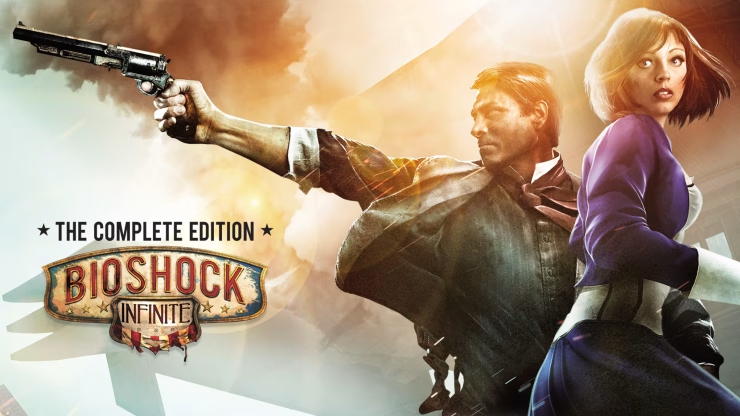
“Indebted to the wrong people, with his life on the line, veteran of the U.S. Cavalry and now hired gun, Booker DeWitt has only one opportunity to wipe his slate clean. He must rescue Elizabeth, a mysterious girl imprisoned since childhood and locked up in the flying city of Columbia.” – Steam Synopsis

Irrational Games – Platform(s): PC, Playstation 4, Xbox One – Genre(s): Action Shooter First-Person FPS RPG Singleplayer – Mode(s): Single-Player – Trailer – Released: 2013
BioShock Infinite confuses me. On one hand, it doesn’t feel like a BioShock game at all, and on the other, it feels like the most BioShock game there is. The first game triumphs with its story and atmosphere, but it has flaws in its gameplay. The second game immensely improves its gameplay, but its story is just solid. Infinite has an amazing story, different but still great gameplay, and themes and imagery so heavy-handed that it almost doesn’t work (and can feel like self-parody at times), but it all ends up coming together really well in the end. As divisive as this game has become over the last 12 years, I’ll say this is my favorite of the trilogy easily, if we’re just talking about the base game.

Speaking just for the main game’s story, this is probably one of my favorites ever. It has its ebbs and flows in the beginning, but just like BioShock, the atmosphere of this city is so amazing throughout that it lifts the game up even during its low points, and by the time things really get going, Booker and Elizabeth’s journey really starts to take off; everything comes together really well. This story is shrouded in mysteries that piece by piece start to fall together until everything is revealed at the end, and it puts an entirely different spin on the journey that we go through with these characters.

The opening scene is the most poetic and beautiful opening in any game I’ve ever played. Booker on the boat approaching the lighthouse, reminiscent of the first game, but instead of going down into a war-torn Rapture, he shoots up into the sky to reach the heavenly city of Columbia, and as you walk through towards the entrance inside this cathedral of holy imagery, there’s a choir singing the game’s main theme, Will The Circle Be Unbroken. And to enter the city, you must be baptized, and once we do enter the city, the blatant symbolism and themes become very prominent.
This is a white nationalist city that worships the founding fathers like gods and also worships the founder of the city, Comstock, as a god and a prophet. There’s racism and slavery, and a revolution brewing under the surface. As Booker and Elizabeth’s journey progresses, they come face to face with all of that, plus the ideas of reality and what it really is. But more than anything, this game is about the cycle (or circle) of reality. Which brings into question, what is choice and free will, what is preordained? What is right or wrong? We see a just revolution turn into a blood bath, just as it was before. We see life choices being made, but is that really their choice? The main game goes strong on these things, and it ends on a very poignant note. A very hard-hitting note, that the DLC simultaneously expands upon and tarnishes, but I’ll talk about that later.

Booker and Elizabeth are the main characters, with Comstock being the ever-looming antagonist. I find their roles in this world, in this city, to complement each other really well. Booker is a hardened war vet, but an outsider to this city. Elizabeth might as well be an outsider because of how she’s been locked up in a tower her whole life, which makes her very naive to life, but especially the more brutal aspects. And Comstock is this prophetic god like figure to the people of Columbia. Booker and Elizabeth, in particular, are very dynamic in their character progression. They rub off on each other in a lot of ways. As the game progresses, it’s clear that there are a lot of similarities between the two, which leads to some really heartwarming but also shocking moments as Elizabeth discovers the world and her powers, and Booker becomes more sympathetic. Comstock is the ever-looming threat, but just by the environmental storytelling alone, you never forget how much power and authority he has. Also, the voxophones do a lot of work building up his character. The home stretch and the ending of this game really turn a lot of what we learn about these characters on its head, and it culminates into something really powerful and emotional that I really wasn’t expecting, but it works, and it makes all three of these characters my favorite in the series.
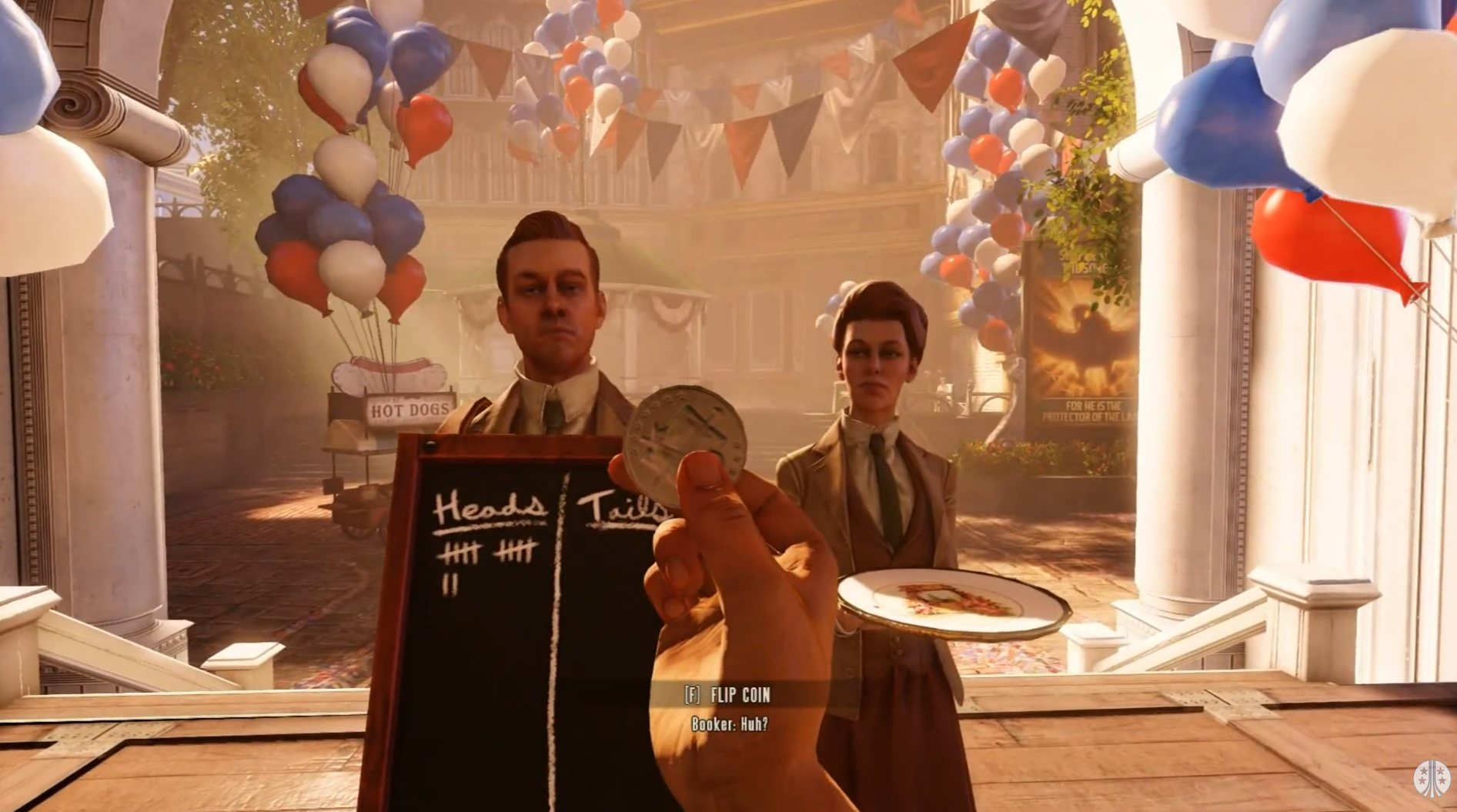
There’s a host of other characters that are met throughout the game, and while they’re good in the main game, the ending and the DLC do a lot of work to enhance their characters and their story while also recontextualizing a lot of things. The Luteces throughout are a fun, enigmatic mystery from beginning to end. Daisy Fitzroy was a great character, and once we started jumping through alternate timelines, she became even more interesting. Which I can say about everyone, really. This game has the best overall group of characters in the series, easily.

So here’s the first bump in the road. While BioShock 1 and 2 are definitely more action-focused than their reputations may give them, they still had a lot of immersive sim elements and combat encounter choices that were fun and made things interesting. BioShock Infinite has none of that. This is a straight-up action FPS. A really damn good one, but it lacks any real deep or meaningful encounter choice that the previous games had. At first, I wasn’t too upset about this (outside of some minor things like only being able to carry two weapons), but the more I played the game, the more I realized how much this gameplay philosophy change morphed the level design. The first two games were allowed to have levels that felt like real enough room designs with puzzles and secrets. While these levels are fun and engaging in their own right, compared to the previous two games, they all felt the same and started to get boring as the game went on. All of the levels felt similarly designed to accommodate the movement and speed of combat, and while it feels great, there was definitely a lot lost in that transition. Overall, though, for what it is, this is a great action FPS with very light RPG elements, and the vigors do add a small but still nice amount of player expression.

In terms of visuals, voice acting, and music, this game has the best in the series in all three categories, pretty much. I do love and appreciate the vibes of Rapture in both previous games, but Columbia is just beautiful in all its “glory” and even in its downfall, and all the universes in between. The opening sequence to this game is one of the best pieces/moments in media that I’ve ever experienced. The countdown, the shooting into the sky, piercing the clouds like you’re going into heaven, and the announcer saying Hallelujah on arrival, which leads into the choir version of Will The Circle Be Unbroken playing as you enter Columbia. Which brings me to the music, which I’ll be honest, I don’t really remember any tracks from the first two games at all. But this game? This soundtrack is amazing, and Will The Circle Be Unbroken is one of the greatest songs ever, and thematically it means so much to this game and franchise. Also, the voice acting from top to bottom is amazing. Booker, Comstock, Elizabeth, any character you can name, the VA work is phenomenal.

If I had just played the main game and sat with it for a bit, I think BioShock Infinite would have been like a solid 9/10, the best game in the franchise, easily, that still has some flaws. But a fun game, with a beautiful world, an amazing story, and characters. But the ending of the main game is not the ending of the story. BioShock Infinite got two DLCs that continue the story of the main game while also connecting this game to the first two, and they’re not good.
Burial at Sea is weird. To get my gripes out of the way, despite my frustrations with BioShock 1’s gameplay, both 1 and 2 did strike that balance of combat choice really well. It felt like almost every encounter was designed for either stealth or all-out guns blazing and everything in between. Infinte’s main game does not have that balance. This is a high-tempo shooter all the way through, which makes Burial at Sea episode 1 so jarring and frustrating. Because we play as a version of Booker in Rapture, with all the tools and level design of all three games mixed, but trying to play this DLC as anything other than a stealth game is torture. It felt like such a mind break to have all the same tools, play as the same character, yet be so limited. I hated it. The story of this first episode is actually super intriguing, and the idea of it in retrospect is cool, but taking into account episode two’s story and reveals, these DLCs end up leaving a bad taste in my mouth.
Episode 2 is a lot better in terms of tone of gameplay. Playing as Elizabeth actually feels right and good for the stealth gameplay they were going for. I actually had a decent amount of fun going through the levels with her. Now, where this episode fumbles (which eventually brings the whole game down) is its story. I won’t go into deep spoilers about it, but it simultaneously conflicts with the ending of the base game while connecting, in an albeit interesting way, BioShock Infinite directly to the first two games. Time travel is such a fickle thing in fiction. Something that we have ideas about how it would work, but as soon as we think too much about it, all of those ideas can fall apart. By the base game’s ending, the way it did time travel and infinite dimensions was tight enough that I could rock with it. This DLC puts a dent into all of that and muddies the story and, more importantly, the ending unnecessarily.

So yeah, in a lot of ways, Bioshock Infinite is the most Bioshock game out of the trilogy. What it lacks in gameplay freedom that the others had, it makes up for in spades with its themes, story, and characters, and even if this is a flat-out action game, it is a damn good one that I had a blast playing. Where it falls flat is its epilogue, aka its DLC. Which, from a gameplay and story perspective, brings the entire package down. I think it’s a cool idea in concept, but Infinite is a complete package on its own, and all the DLC did was leave me confused, frustrated, and with a bad impression on the way out. Still, this was a very fun game, and I’m glad that I finally got to appreciate this game series in its entirety. I’m sad that it’s over, seeing as the latest game has been in development hell, and who knows when Judas is coming out. I guess the next best thing is the Clockwork Revolution game revealed last summer. So until then.
BioShock Infinite – 8/10