“When a 13-year-old is accused of the murder of a classmate, his family, therapist and the detective in charge are all left asking what really happened.” – IMDB Synopsis
Mild spoilers ahead. I highly recommend at least watching episode 1 before reading the rest of this.

Jack Thorne – Directed by: Philip Barantini – Genre(s): Psychological Drama, Crime, Drama, Mystery, Thriller – Trailer – Release Year: 2025
Adolescence is must watch TV. No matter the quality of a piece of media, everything has themes and a meaning. It’s just natural given how stories form and are presented to us. But not everything genuinely has something to say. Not everything has a point, a message that needs to be heard. There is so much to talk about in this miniseries. The acting, the direction, the music, etc. I want to appreciate the greatness of all those things while also never forgetting the message that this is loudly yelling at the audience. We now live in a world where a great portion of the population has grown up with the internet. And it is no longer enough to try to protect your child from bad influences in real life. It never has been easy, but it’s harder than ever to protect your child from bullying and those bad influences when the internet exists. In the world we live in now, everyone is more vulnerable than ever and seriously, it seems like there’s no escape.

The intensity of this show is something special. It comes down to the way it’s shot, the amazing performances, and how real this story is. This is a very grounded show. The fact that each episode is one singular shot and scenes move in real time adds so much to that realism. The performances are honestly award worthy. Especially Jamie (Owen Cooper) and Eddie (Stephen Graham). Something that this show does so brilliantly is presenting this case in such a way that at first it’s hard to sympathize with Jamie at all. But then as the story progresses and more things come out about the case, that conflict starts to set in. There are so many moments in this show that are tear inducing. Parts of episode 2, and the end of episode 4, especially. But what really got me and brought tears to my eyes is episode 3.

Episode 3 is just Jamie one of his psychiatric evaluators for the vast majority of the episode months after everything has unraveled. And in episode 1, Jamie is so quiet and to himself even while everything is going down. He is very much a kid that just got into big trouble in that episode. In episode 3, with his parents not around and in the presence of a person, a woman, who he clearly likes and finds some sort of attraction in. He opens up so much more and it’s in that where it all hit me. Jamie is a child. A poor conflicted, corrupted, angry child who, despite coming from a solid home and parents who tried to instill good values in him and a father who was, by all accounts, an alright man. He, and everyone else around him, was pulled into this toxic mindset that has always been a thing but is almost inescapable now because of proponents like Andrew Tate (I’m so glad they name dropped him in this show). This toxic mindset that on the surface promotes male positivity but right underneath it all is misogyny, toxic masculinity, and actually leads to men and young boys especially feeling worse about themselves. And on top of that, young woman see this stuff too and believe it and take these things to heart. It is a viscous viscous cycle that really upsets me, because Jamie isn’t a fictional boy. The school he goes to isn’t fictional. The students there aren’t fake, the girl that was murdered isn’t fake. This is real, this is an epidemic, and it almost feels impossible to stop. There’s too much money and power in making these boys, these children, young men, feel this way. Feel like women are objects, or out to get them, or only desire some 20% of men. The manosphere is a machine built on these children feeling lost, alone, and angry. And it’s deeply depressing that there seems to be no resolution.

It also really bothered me how the school children reacted to everything. This is something that I have actually come to realize of in the past few years and why I have taken big steps back from social media. I know they’re just kids, but there comes a point where it needs to be understood that not everything is a joke. Not everything is to be laughed at. Social media has made everyone so desensitized to everything. There’s no such thing as a serious moment anymore when two seconds later it gets turned into a meme, three seconds later it’s turned into some edgy joke to laugh at, and four seconds later it’s completely forgotten.

Outside of Jamie, I loved how this show focused on how what happened affected everyone around him. From his community to his family. With that, there are so many powerful performances and moments. Episode 2 was pretty special and also anxiety inducing. I thank god every day that I went to a middle school and high school that each never had over 400 students. Episode 4 circles back to the family and the dad in particular and it’s really, really heartbreaking and eye opening. A lot of crime dramas or even crime in real life tend to focus on the crime, the criminal, kind of the victim (this is touched on really well in episode 2 actually). But these crimes don’t happen in a vacuum and time doesn’t stop when they do. Real people who live real lives are affected and still have to go on living their life. That’s what made episode 4 so powerful. There’s like a 7 minute scene of just the family in the car talking and having a laugh and it hurt me seeing them like that, knowing that deep down their lives will never be the same, not because of something they directly did. It hurts seeing the dad and mom question their parenting, feel responsible for what their child did. Stephen Graham gives such an amazing performance really, there’s so much pain in his heart and it comes through in every scene. There was a lot of music and audio effects used during some of his scenes that really added to it.
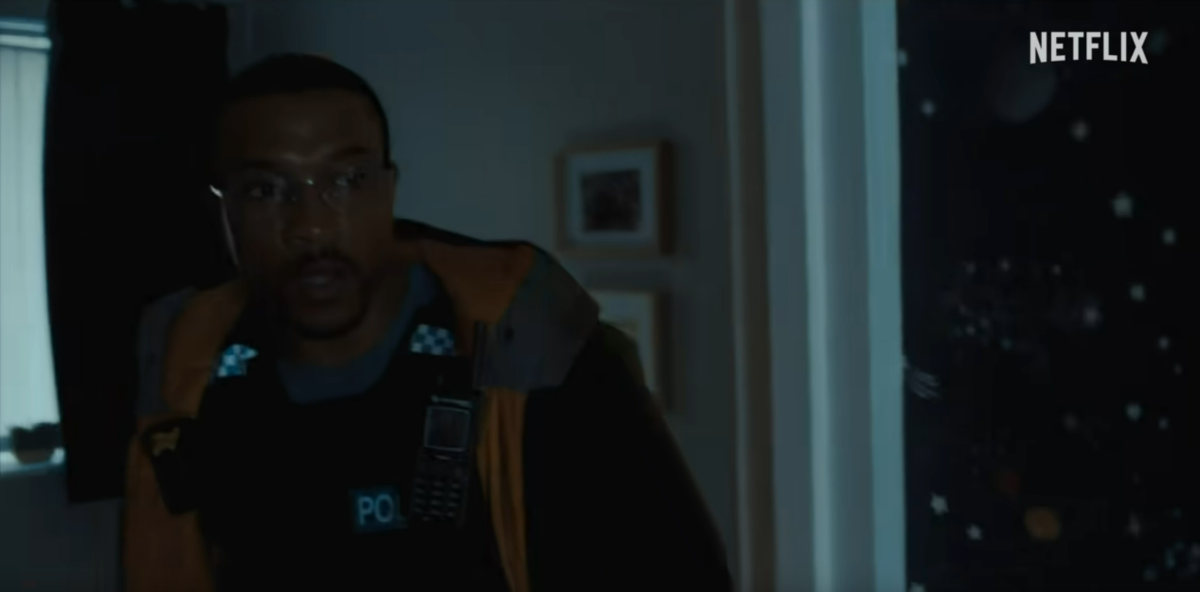
Sometimes things shot in one take can feel gimmicky, but not here. It works so well. The one take makes this whole thing feel grounded and real. And I love the techniques they employed to make this a reality. One of my favorite things to do while watching this is to try to guess how they would get the camera to a different room. Because it doesn’t always make sense for the camera to follow one character to a room, then another walks in and now they’re the focus for the next scene. They don’t constantly have pivotal characters interacting with each other just for the sake of moving the camera. And the camera never just floats from room to room without a focus. So I don’t know the exact term for this, so in my mind I just called them “pivot characters.” Sometimes main characters, sometimes completely inconsequential characters, but the camera will just follow them for maybe just 30 seconds just to move it to another room for a scene to start and then they would leave. I thought that was so cool. I’m also very interested in the process behind the drone shot in episode 2 and the car shots in episode 4. I know it must’ve taken so much to get all of this right and the end result paid off really well.

So yeah, I loved this show. It really had something to say about the current state of the world, specifically as it pertains to children and the surrounding influences on them (particularly on the internet). It said its peace loud and clear and I think it needed to be said. I’m glad it called out names like Andrew Tate. I’m glad it broke down terminology used by the manosphere. This is an important piece of media. Yes, I can and have applauded the cool directing techniques and amazing performances throughout this post. But above it all, it needs to be understood that this is real. Jamie could be anyone’s son, brother, nephew, cousin. The sad reality is that these bad influences have probably already gotten to them, so it is important have conversations, talk to them. Never before has so important to have good adult influences in children’s life. Never before has it been so hard to protect your children. But we have to try.
Adolescence – 10/10